Why Your Essay Isn't Scoring Higher
There is a particular kind of frustration that belongs only to the student who is doing everything right.
You understand the texts. You hand work in on time. You have read the assessment criteria. Your marks are respectable, somewhere in the twenties out of thirty, and they have been respectable for two years. They are also not moving.
The feedback does not help. Add more analysis. Go deeper. Develop this further. You have read those words so many times they have stopped meaning anything at all.
In more than a decade of teaching VCE English, I have watched a lot of capable students sit at that ceiling. What is striking is how few of them are stuck for different reasons. Almost always it comes down to the same short list.
Here is that list, and what to do about each one.
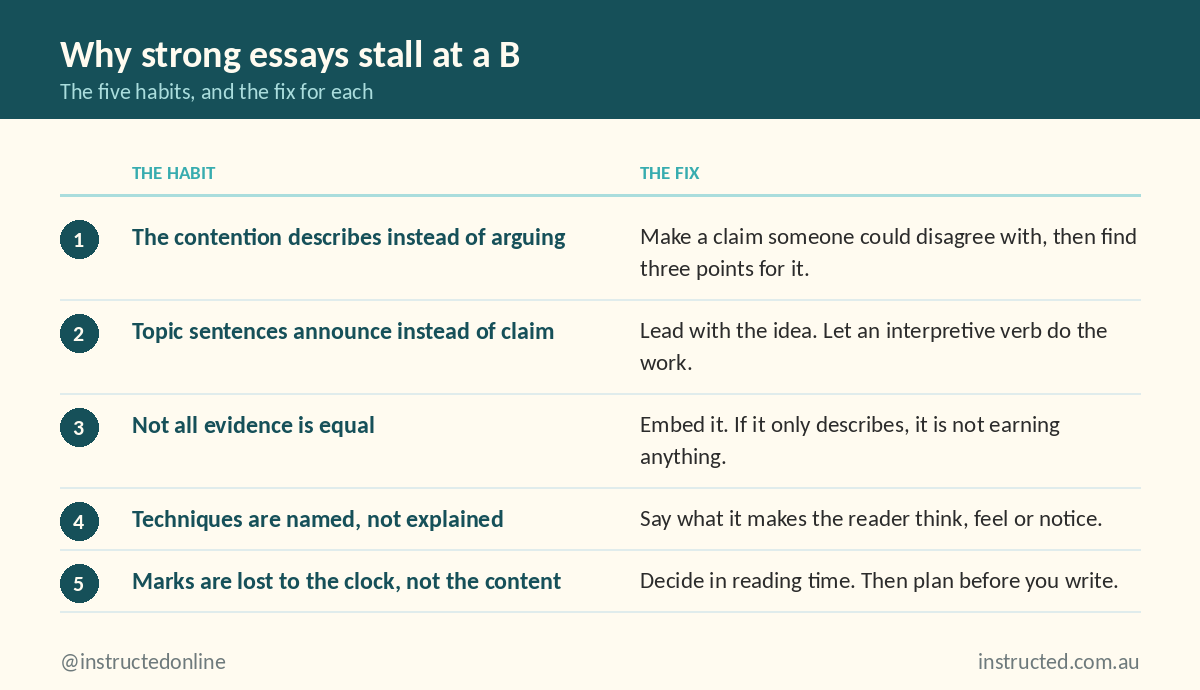
1. Your contention describes instead of arguing
Your contention is not an introduction to the topic. It is a one or two sentence answer to the prompt, and every paragraph that follows exists to defend it.
That means it has to be worth defending. A contention that nobody could disagree with is not a contention. It is a summary wearing a contention's clothes.
In Macbeth, Shakespeare explores the role of ambition.
Well, yes. But there is no claim here, and no interpretation. An examiner cannot reward an argument you have not made, and if your opening position is a statement of the obvious, every paragraph underneath it can only restate the obvious in more detail. You have capped your own marks before the first body paragraph.
Your contention is also your first and best chance to show the assessor a sophisticated reading of the text. It needs to address the topic, the whole topic, and its implications. Prompts almost always carry a loaded word or an assumption inside them, and the students who score highest are the ones who notice it.
Take a prompt like "Macbeth is destroyed by his own ambition. Do you agree?" The word doing the real work there is own. The prompt is quietly asking a question about agency: how much of this is Macbeth, and how much is the world around him? A contention that ignores that word has only answered half the question.

The three point test. Before you write a word, see whether you can name at least three distinct points that support your contention. Those points are your body paragraphs. If you cannot find three, the problem is not that you need more evidence. Your contention is not strong enough yet and needs reworking now, not halfway through.
Ask yourself: is my contention making an arguable claim that addresses the implications of the prompt? If not, keep pushing until it takes a position worth exploring.
2. Your topic sentences announce instead of claim
A topic sentence has two jobs. It must support your contention, and it must make a point distinct from every other paragraph.
Most topic sentences that hold students at a B do neither. They name a subject instead.
The witches in Macbeth are used as instruments of manipulation.
Shakespeare uses imagery to highlight the destructive nature of ambition.
Both are accurate. Neither makes an arguable claim. The paragraph that follows will read as a collection of observations rather than a step in an argument, no matter how well observed those observations are.
Two changes fix most of them.
Let your verb do the heavy lifting.Depicts, shows, uses and explores are not wrong, but they are neutral. They report. Verbs like challenges, criticises, condemns, undermines and complicates set up an interpretation before the sentence has even finished. The verb tells the assessor you are reading the text, not just describing it.
Lead with the idea, not the character. You have probably been told to focus on ideas rather than characters, or rather than one particular poem or story. The reason is simple: a topic sentence has to establish the concept you are about to explore. A character or a single text is too narrow to build an argument on, and it traps you into retelling rather than arguing. Characters, poems and scenes are your evidence. The idea is your claim.

Try this. Write all three topic sentences first, before any body paragraphs, then read them in order on their own. They should hold together as a short argument that answers the prompt. If they read as three unrelated observations, you have found the problem before you wasted an hour writing it out.
3. Not all evidence is equal
Marks are not awarded for the inclusion of quotations. There is no quote quota.
Quotations, stage directions, structural choices, literary devices, camera angles: all of it is evidence, and evidence only earns anything when it supports the claim in your topic sentence, which in turn supports your contention. Evidence that is doing neither is decoration.
There are two questions worth asking of every piece you use.
Is it embedded? Your words plus the quotation should form one complete, grammatical sentence. A quotation that sits on its own, dropped in after a colon and left there, signals that you have found something rather than that you are using it.
Does it support the interpretation, or just describe? This is the harder one, because descriptive evidence feels productive. It is accurate. It is relevant. It simply is not doing any argumentative work.
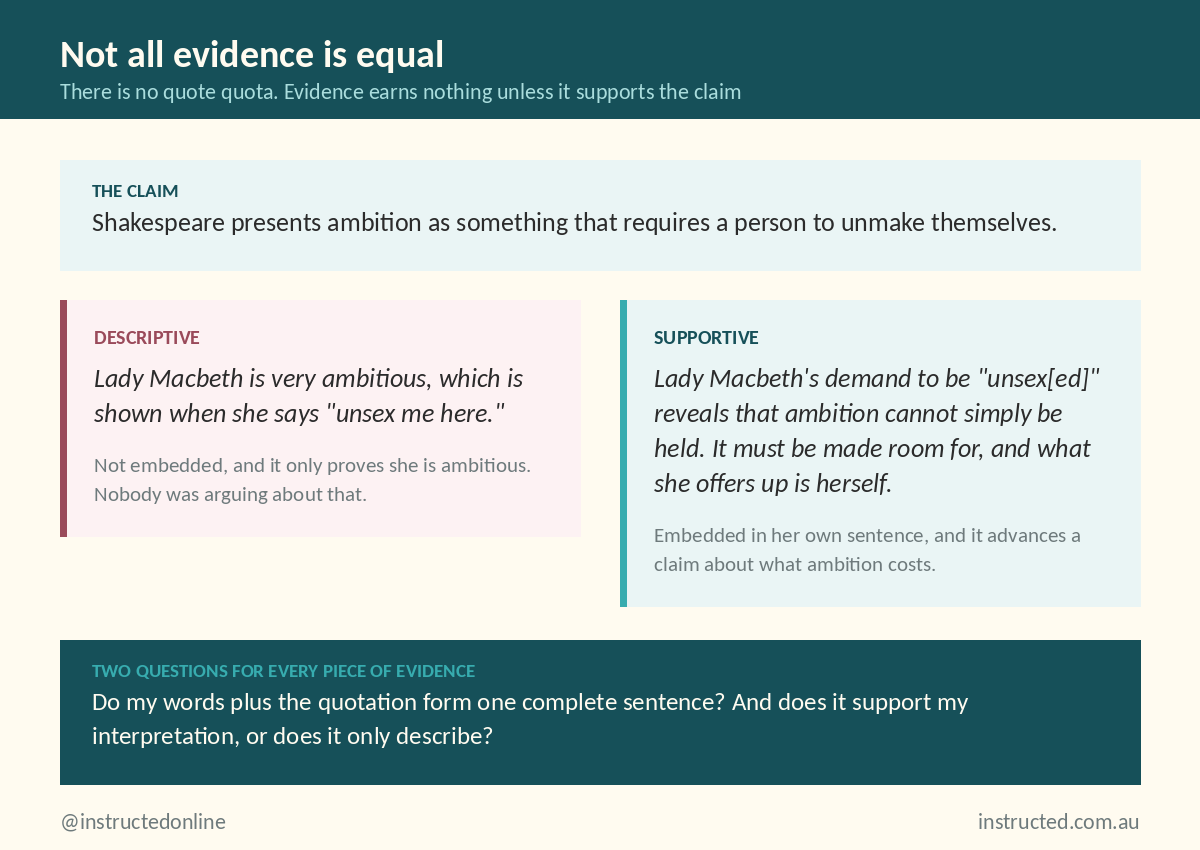
Say your claim is that Shakespeare presents ambition as something that requires a person to unmake themselves.
Descriptive: Lady Macbeth is very ambitious, which is shown when she says "unsex me here."
Supportive: Lady Macbeth's demand to be "unsex[ed]" reveals that ambition cannot simply be held. It must be made room for, and what she offers up is herself.
Same quotation. The first proves she is ambitious, which nobody was arguing about. The second uses her language to advance a claim about what ambition costs.
4. You name techniques instead of explaining effect
Technique-spotting is the most common ceiling for capable students. Naming a device accurately proves you can recognise it. Explaining what it does to a reader proves you can analyse. Only the second earns the higher grades.
The use of metaphor emphasises the character's isolation names and moves on. It does not tell me what the metaphor makes me notice that I would not have noticed otherwise.
After every technique you name, answer one question in writing: what does this make the reader think, feel, or notice? That answer is your analysis. The technique was only the way in.
This is also where the balance of your paragraph gets decided. A paragraph that is two-thirds quotation looks thorough. It reads as diligent. It scores mid-range, which is exactly why it is so difficult to catch yourself doing it.

Count the lines. If your analysis is shorter than your evidence, cut a quotation rather than adding another. One quotation discussed properly will outscore three mentioned in passing, every time.
5. You are losing marks to the clock, not to the content
If you are consistently producing strong practice pieces and your SACs come back rushed or unfinished, your problem is not comprehension. It is decision-making under pressure, and it is a separate skill that most students have never explicitly practised.
Under timed conditions, a complete average response outscores an incomplete brilliant one. Assessors can only mark what is on the page.
Two things help.
Use reading time properly. You cannot write during reading time, so use it to make decisions in your head: which prompt, which argument, which evidence. Decide before the pen moves.
Plan. This cannot be overstated. There is nothing that will serve you better under time pressure than a plan. A plan surfaces a weak contention or a repetitive topic sentence before you begin rather than halfway through. It saves you from rewriting. Most importantly, it lets you stress test your ideas while they are still cheap to change.
Ten minutes planning and forty minutes writing will beat fifty minutes of writing, almost every time.
What to actually do with this
Reading this will not change your marks. Applying one of these to one piece of writing will.
Pick the reason that stung the most. Take a single paragraph from your last essay and rewrite it with that fix in mind. That is the whole task, and it will teach you more than another read-through of your notes.

Free download: I have put these five reasons into a printable guide with a six-question checklist to run over any draft before you hand it in. Just enter your email below and I’ll send you the guide.
If you want to practise under real conditions, there are full practice exams with suggested answers and marking criteria in the InstructED resources library.
Yvie is the founder of InstructED. She holds a Master of Teaching, is VIT registered, and has taught VCE English and History for over ten years.