How to Deconstruct a VCE History Essay Question (Before You Write a Word)
Every year, examiner reports make a version of the same observation. Students who clearly know their revolutions still lose marks. They know the events, the dates, the individuals. They have done the reading. And their responses still underperform.
The problem is rarely knowledge. It is that they answered the topic rather than the question.
These are not the same thing, and the difference is decided in the first ninety seconds of an exam, before a single sentence gets written.
Answering the topic is easier, which is why it happens
When you read an essay question, your brain does something helpful and slightly dangerous. It recognises the subject matter. Ah, the October Revolution. I know this.
That recognition feels like comprehension. It isn't. It's pattern-matching, and it produces essays containing a great deal of accurate material about roughly the right subject, arranged in roughly the right order, that never quite answer what was asked.

The test in that image is worth committing to memory, because it works on any sentence you write. If nobody could reasonably disagree with it, you have described something. If they could, you have made an argument.
The defence against answering the topic is mechanical. Before you plan anything, take the question apart.
The five elements worth marking up
Here's the whole method on one question.
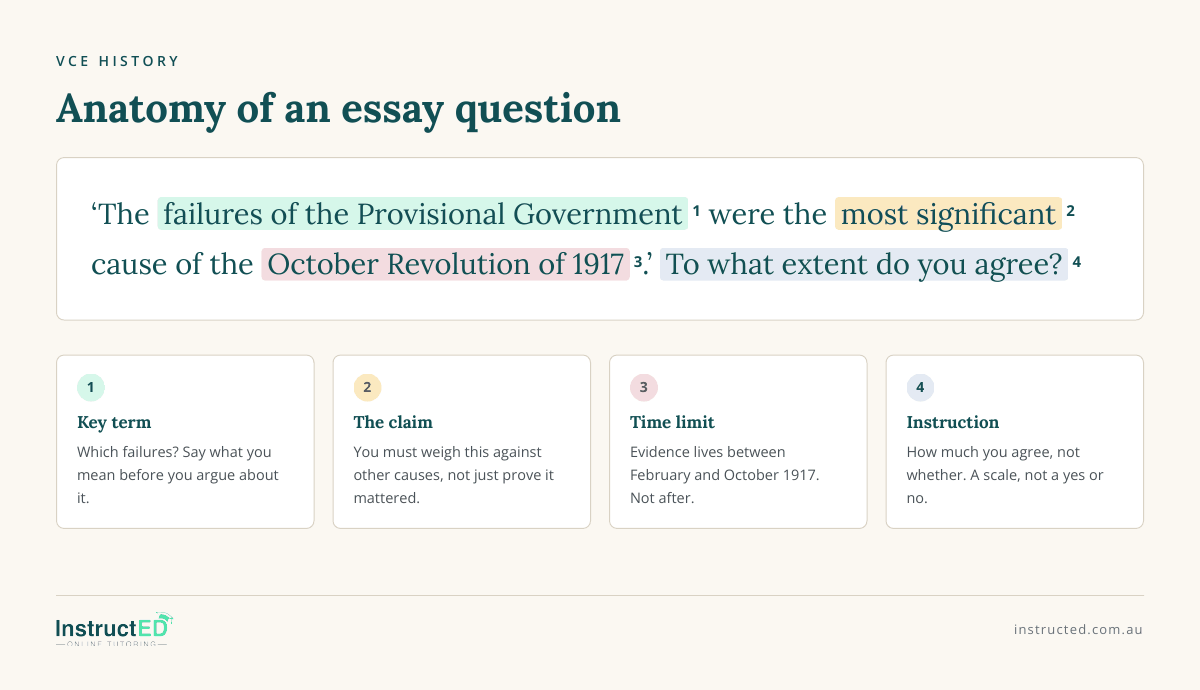
Now the detail.
1. The instructional term
This is the single most under-read phrase on any exam paper. It tells you what to do with the material, and two students who know identical content can be separated entirely by which one noticed it.
Explain — establish how or why something occurred
Analyse — break something into parts and show how they relate
Evaluate — make a judgement, and justify it
To what extent — supply a degree, not a verdict
Our question uses to what extent. Hold that thought, because it does more work than the others.
2. The claim being made
Essay questions are rarely neutral. Ours proposes that the Provisional Government's failures were the most significant cause.
That word most is the entire task. You are not being asked whether the Provisional Government failed. It plainly did. You are being asked to weigh those failures against everything else: Bolshevik organisation, war weariness, the land question, Lenin's return, the Kornilov affair.
Something can be enormously significant and still not be the most significant. If your essay only demonstrates that the Provisional Government failed badly, you have proved something nobody disputed.
3. Named dates
Our question says 1917, and locates itself more precisely at the October Revolution.
That's a limit. Evidence from February 1917 is relevant, because it explains what the Provisional Government inherited. Evidence from the Civil War is not, because it comes after the thing you're explaining.
Essays that drift past their date boundary are extremely common and visible to a marker instantly. If a question names a date, you've been handed a scope limit. Use it. It protects you as much as it constrains you.
4. Key terms that need defining
The failures of the Provisional Government. Which failures? The refusal to leave the war? Dual power with the Petrograd Soviet? The delay on land reform? The handling of Kornilov?
You can't be marked on how well you explained something you never established. Define the term early, briefly, in your introduction, and the whole essay gains precision.
5. What kind of answer the question wants
This is where to what extent earns its keep.
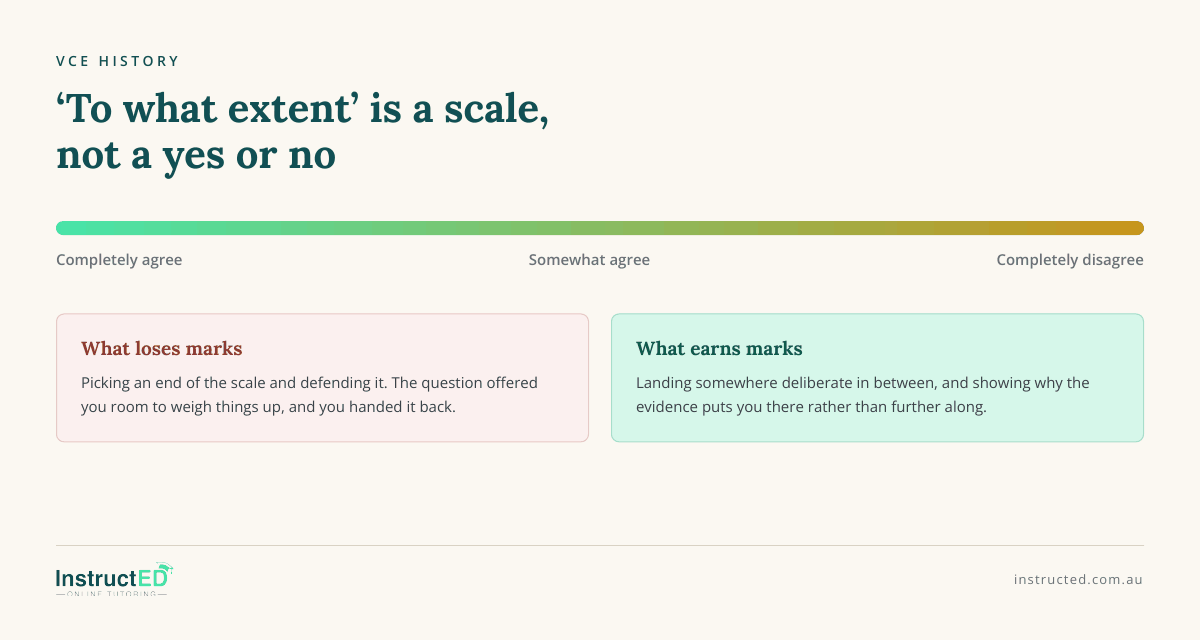
The most common error is reading to what extent as though it means do you agree. It doesn't. It's asking you to place yourself on a scale, and an essay that completely agrees or completely disagrees has flattened that scale into a yes or no question.
You've given away the analytical range the question was offering you.
What deconstruction actually buys you
Run those five elements on our question and you arrive somewhere specific.
You now know you're being asked to weigh the Provisional Government's failures against alternative causes. You know you need to land on a considered position rather than a yes or no. You know your evidence lives between February and October 1917. And you know you need to establish which failures you mean before you can argue about their weight.
That is not yet an essay. But notice how much of the essay it has already determined, and how little of it you could have determined by simply recognising the topic.
One test before you plan
Write your position in one sentence. Then ask whether someone who knows the topic could argue the opposite.
If they couldn't, you've written a description rather than a contention, and no amount of good evidence underneath will fix that.
The step most students skip is the cheapest one

Deconstruction takes about ninety seconds. Under exam pressure ninety seconds feels expensive, which is exactly why it gets skipped, and exactly why skipping it is such a reliable way to lose marks you'd already earned through months of study.
You can't control which question comes up. You can control whether you answer it.
Take one question all the way through
Deconstruction is the first of six planning steps. Our guide How to Plan and Structure a VCE History Essay follows a single question from first reading to finished conclusion: the brainstorm, the grouping, the contention, the topic sentences, and a fully annotated model introduction, body paragraph and conclusion showing exactly where marks are earned.
It also includes a blank planning template for your own questions.
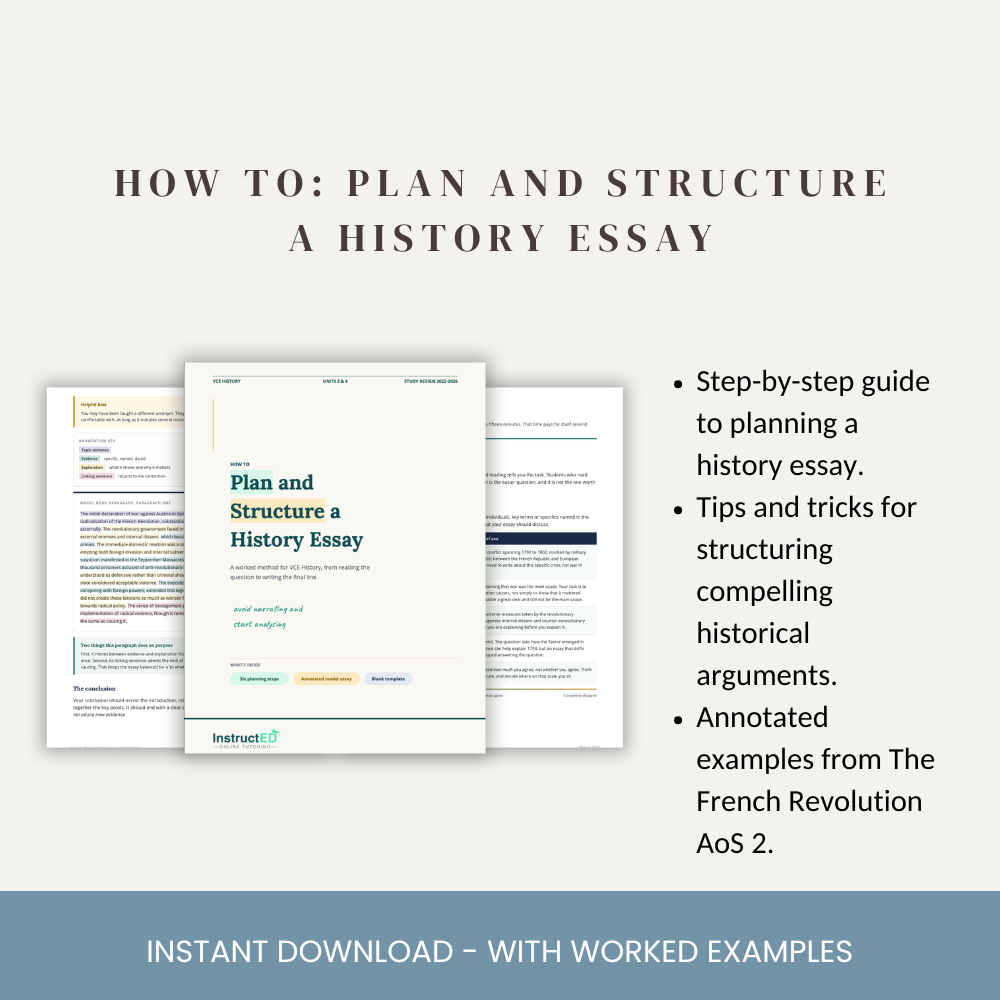
Most students lose marks in History not because they lack knowledge, but because they answer a slightly different question from the one on the paper, or retell events instead of building an argument.
Both problems are decided before you write a single sentence. They are planning problems, and this guide fixes them.
What's inside
Twelve pages taking one VCE essay question the whole way through, from first reading to finished conclusion.
Six planning steps — deconstructing the question, brainstorming, grouping your points, writing a contention and topic sentences
An annotated model essay — introduction, body paragraph and conclusion, colour-coded so you can see exactly where marks are earned
A blank planning template — for use on your own questions, again and again
Common mistakes — the five ways strong students lose marks on this task
Written for the current study design
Built against the VCAA History study design 2022–2026, by a qualified, VIT-registered classroom teacher who writes VCE resources for Edrolo and delivers professional development for the History Teachers' Association of Victoria.
Which revolution is it for?
The worked example uses the French Revolution, but the method is not specific to one revolution. Every step applies equally to the American, Russian and Chinese revolutions. Only the evidence changes.
Please note
This is a skills guide, not a course guide. It teaches you how to plan and write a History essay. It does not summarise course content or supply revision notes.
Instant digital download. PDF, 12 pages, A4.
InstructED is a small VCE English and History tutoring practice in Melbourne. Every session is taught by a qualified and experienced VCE teacher.